


What is the Big Five (the Five Factor Model)?
Understand what the Big Five model is, what the five personality traits cover, how the theory came about, and how the Big Five is used in modern personality testing and HR practice.
The Big Five model is one of the most recognised and scientifically validated ways of measuring personality. For HR professionals and managers, it's an essential tool for predicting workplace behaviour and securing a successful match in recruitment. Read on to learn how the five traits work, and why they form the foundation of modern testing tools like OPTO.
What is the Big Five model (the Five Factor Model)?
The Big Five, also known as the Five Factor Model (FFM), is a psychological taxonomy that describes personality across five overarching dimensions. Unlike type based tests (such as MBTI or the Enneagram), it doesn't put people into boxes. Instead, personality is measured on continuous scales.
In modern HR and psychological research, the Big Five is considered the gold standard because it is:
- Culture independent: Results are stable across countries and languages.
- Valid: It offers a high degree of precision in predicting job performance.
- Stable: Personality traits change minimally throughout adult life.
The 5 personality traits (OCEAN)
To make the five dimensions easy to remember, the acronym OCEAN is often used (Openness to Experience, Conscientiousness, Extraversion, Agreeableness, Neuroticism). Below, we look at how each trait affects behaviour in the workplace:
1. Openness to Experience
Describes intellectual curiosity and openness to change.
- High score: Innovative, creative and a strategic thinker.
- Low score: Practical, down to earth and prefers familiar methods.
2. Conscientiousness
The strongest marker of overall job success. It's about self-discipline and organisation.
- High score: Structured, reliable and goal oriented.
- Low score: Flexible, spontaneous and thrives with unstructured tasks.
3. Extraversion
Describes where a person draws their energy from and their degree of social orientation.
- High score: Energetic, talkative and thrives being the centre of attention.
- Low score (Introversion): Reflective, prefers depth over breadth in social relationships.
4. Agreeableness
Measures the degree of trust, empathy and willingness to cooperate.
- High score: Team player, diplomatic and helpful.
- Low score: Competitive, critical and direct in communication.
5. Neuroticism
Measures resilience to stress and emotional influences.
- High stability: Calm under pressure, optimistic and resilient.
- Low stability (High Neuroticism): Alert to risk, sensitive to criticism and thorough in their thinking.
The history: From language to science
The work of understanding personality dates back to the early 20th century, but the Big Five model grew out of a lexical approach from the 1940s onwards. It builds on the lexical hypothesis, the idea that all significant personality traits have, over time, become encoded in our language. Psychologists assumed that personality is described in language, and so began analysing thousands of personal adjectives.
Through statistical analysis, particularly factor analysis, researchers such as Raymond Cattell, Ernest Tupes and Raymond Christal, and later Lewis Goldberg and Costa & McCrae, were able to identify five consistent and robust personality dimensions. In the 1980s, the model was firmly consolidated as the "Big Five" and is today regarded as the most empirically well documented personality model in psychology.
The Big Five is, in fact, not a theory but rather a statistically grounded way of measuring personality.
Why the Big Five matters for HR and recruitment
Using a personality test based on the Big Five in business delivers a number of benefits that show up directly on the bottom line:
- Higher predictive validity: You get a more accurate picture of how a candidate will perform in the role.
- Less bias: The model is objective and scientific, which reduces gut-feeling decisions in the hiring process.
- Nuanced reports: Because traits are measured on scales, you get a unique fingerprint of the candidate rather than a generic type description.
Did you know? Research shows that the Big Five is the most valid way of measuring personality. Source: Master International.
From theory to practice: OPTO personality test
While the Big Five is the foundation, it takes a professional tool to make the science usable in practice.
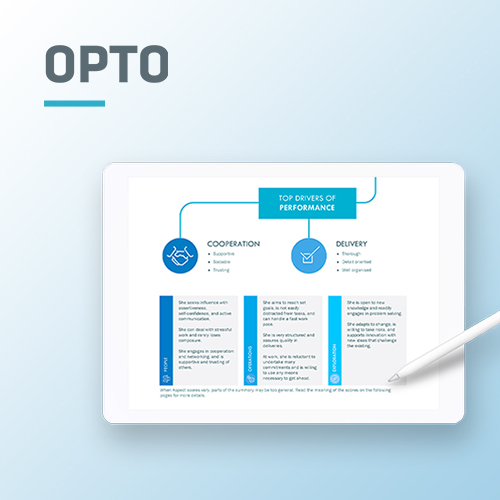
OPTO is a modern personality test built directly on the Big Five framework. OPTO takes the complex psychological dimensions and translates them into job relevant behaviour.
With OPTO you get:
- Insight into the candidate's strengths and challenges in a work context.
- Tools for data driven recruitment and talent development.
- A shared language for personality across the whole organisation.
Want to see how the Big Five can elevate your recruitment? Read more about OPTO here.
Better collaboration and communication: EASI typology
EASI is likewise rooted in the Big Five, but with a particular focus on an individual's preferred behaviour in collaborative settings. EASI analyses the five dimensions to give insight into how a person interacts with others, prefers to communicate, and which roles they typically take on in teams.
With EASI you get:
- Insight into behaviour and motivation.
- A GAP analysis: whether there's overlap or a significant gap between what the person does and what motivates them.
- EASI is ideal for strengthening team collaboration and resolving conflict, as it highlights the individual differences that shape a group.
Want to see how the Big Five can elevate your team or employee development? Read more about EASI here.
OPTO personality test
OPTO is a personality test based on the Big Five, the most recognised theory in the field. The test helps you quickly get to know a person, with a particular focus on job performance. You can use OPTO for, among other things:
FAQ: Frequently asked questions about the Big Five in recruitment
1. What is the difference between the Big Five and personality types such as MBTI?
The difference is that the Big Five measures personality traits on a sliding scale, while type tests (like MBTI) place people into fixed boxes or categories. In modern organisational psychology, the Big Five is preferred, as it is scientifically validated for recruitment and gives a far more nuanced and accurate picture of a candidate's actual behaviour.
2. How can the Big Five model predict success in a job?
The Big Five predicts job success by measuring traits that have a direct statistical link to how work is handled. For example, Conscientiousness is the strongest indicator of overall performance, while Emotional Stability predicts how a candidate handles stress and pressure. Matching these traits against the job requirements significantly reduces the risk of a bad hire.
3. Is the Big Five model scientifically recognised?
Yes, the Big Five is the most well documented and empirically well founded personality model in the world. It's based on decades of independent research and factor analysis, which means it has very high validity (it measures what it claims to) and reliability (it gives stable results over time). This makes it the gold standard in both research and professional HR.
4. What's the advantage of using a Big Five test like OPTO?
The advantage of a Big Five based test like OPTO is that it translates complex psychological theory into practical, job relevant behaviour. Where the theory describes personality broadly, OPTO focuses specifically on the competencies and motivational factors that make a difference in the workplace. This gives hiring managers and HR consultants a shared, factual language.


