


How to distinguish between our Cognitive tests
At Master International, we offer two cognitive tests: ACE and CORE. Both tests help organizations assess candidates’ cognitive abilities in relation to job complexity, making it easier to ensure the right match between role and individual. But what sets the two tests apart? In this article, we explain the key differences.
Modern recruitment processes combine multiple methods – including data-driven solutions such as cognitive tests – to achieve high predictive validity. High predictive validity increases the likelihood of identifying the candidate with the greatest potential for job success, which is exactly what you can achieve by using ACE and CORE.
But when does it make sense to use one test rather than the other? In this article, we take a closer look at the differences between the two cognitive tests and outline when each test delivers the greatest value in the recruitment process.
Regardless of which cognitive test you use in recruitment, it is always important to consider the level of complexity the job entails. Once you have assessed how complex the tasks are that the candidate will need to handle, you can set clear criteria and thereby identify the right match.
ACE vs CORE: How they differ
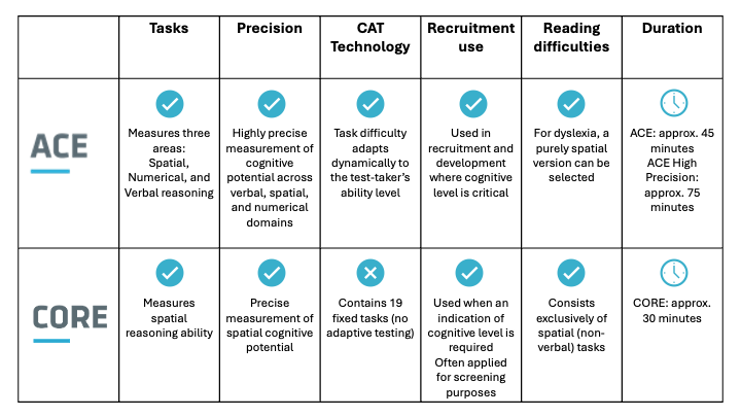
Both ACE and CORE cognitive tests are valuable tools in the recruitment process, as they make it easy to identify candidates who best match the complexity of the role. However, the two tests differ across six key parameters:
- Tasks
- Accuracy
- CAT Technology
- Duration
- Recruitment focus
- Reading difficulties
The general differences between ACE and CORE are outlined in the table below.
Tasks
Both ACE and CORE measure General Mental Ability (GMA), which is the strongest predictor of job performance and the ability to acquire new knowledge. The difference between the two tests is that CORE focuses exclusively on spatial tasks, whereas ACE includes a combination of spatial, verbal, and numerical tasks (see examples of tasks below).
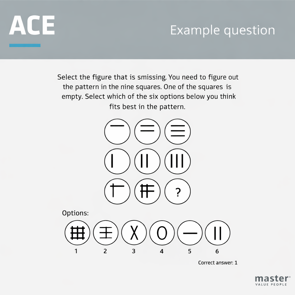
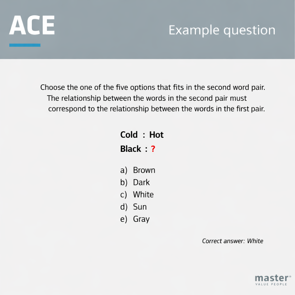
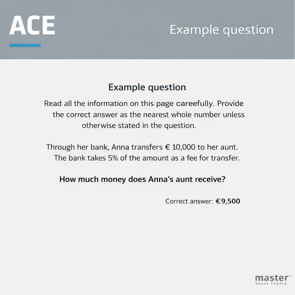
Example of a Spatial Task Example of a Verbal Task Example of a Numerical Task
DO YOU WANT TO KNOW MORE ABOUT GMA AND COGNITIVE TESTS? CLICK HERE
Accuracy
Both ACE and CORE provide precise assessments of a candidate’s cognitive abilities. CORE is a strong choice if you want a reliable evaluation of job success. If, however, you are looking for a highly precise assessment, we recommend using ACE.
CORE consists of fixed spatial tasks, whereas the difficulty level in ACE adapts based on the candidate’s responses. This is made possible through the use of advanced CAT technology.
CAT Technology
CAT technology – Computer Adaptive Testing – is used in the ACE test. This means the test is designed to be challenging for everyone, as the difficulty level continuously adjusts based on the candidate’s responses.
This technology is not used in CORE. As a result, all CORE test-takers complete exactly the same tasks, regardless of their responses.
Recruitment
Cognitive tests like ACE and CORE are powerful tools in recruitment, but they deliver the most value at different stages of the process.
ACE is particularly valuable when you want a highly precise measurement of candidates’ cognitive abilities, for example in the later stages of recruitment when the candidate pool has been narrowed. This is because ACE includes numerical, verbal, and spatial tasks and uses CAT technology, which together provides deep insights into a candidate’s potential for job success.
CORE, on the other hand, consists solely of spatial tasks and takes approximately 30 minutes to complete. This makes CORE especially suitable for screening larger candidate pools, providing a reliable assessment of candidates’ cognitive abilities in relation to the complexity of the role.
Not sure which test tool best suits your needs? Try the test “Find the right solution!” here
Reading Difficulties
At Master International, we are committed to ensuring fair assessments and creating a positive, user-friendly experience for all test-takers. We therefore always encourage test administrators to provide the best possible conditions for candidates with reading difficulties.
If you know a candidate has reading difficulties, such as dyslexia, or suspect it after the test, we recommend that for ACE you test the candidate using only the spatial tasks (you can easily select the test without numerical and verbal tasks in MPP). This does not affect the use of CAT technology, which still adapts to the candidate’s responses.
For CORE, the test is entirely non-verbal, giving equal conditions for candidates with or without reading difficulties – provided the test administrator ensures that candidates with dyslexia understand how to complete the tasks. It is therefore always a good idea to inform candidates about the option to have a linguistically skilled person read the instructions aloud to prevent misunderstandings.
Do you have questions about reading difficulties and testing? You are always welcome to reach out to us by email
Duration
- CORE: around 30 minutes
- ACE: around 45 minutes
- ACE high precision: around 75 minutes